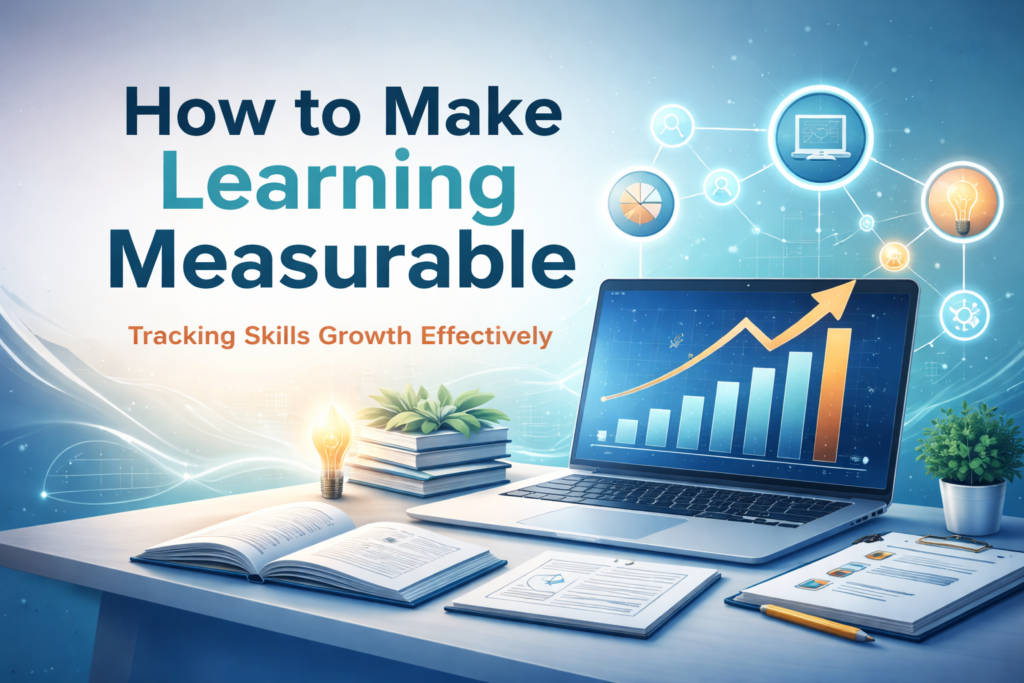
In many education systems, learning is often measured by completion.
Assignments submitted.
Projects finished.
Chapters covered.
Attendance recorded.
But completion does not necessarily equal competence.
If education is to truly nurture capability, confidence and adaptability, we must rethink what it means to measure learning.
The Problem with Completion-Based Metrics
Completion rates are easy to track.
They provide visible data points and administrative comfort. However, they rarely reflect whether a student:
- Understood the concept deeply
- Can apply the skill independently
- Has internalized the learning
- Can transfer knowledge to new contexts
Measuring learning purely by output risks rewarding compliance rather than mastery.
Shifting from Activity to Skill-Based Measurement
True learning becomes measurable when we shift focus from:
“What was done?”
to
“What can now be done independently?”
Skill-based measurement evaluates:
- Application
- Retention
- Transferability
- Adaptability
- Confidence in execution
For example:
Instead of asking whether a child completed a math worksheet, we ask:
- Can they explain the reasoning?
- Can they apply the concept in a real-life scenario?
- Can they solve a variation independently?
That shift changes the educational objective entirely.
Designing Measurable Learning Frameworks
To move toward meaningful measurement, schools and educators can integrate:
1️⃣ Clear Skill Definitions
Each lesson should define:
- What skill is being developed
- What proficiency looks like
- What partial mastery looks like
Clarity reduces ambiguity in evaluation.
2️⃣ Observable Indicators of Growth
Skill measurement requires observable markers such as:
- Problem-solving approach
- Communication clarity
- Ability to teach the concept to others
- Behavioral consistency
These indicators reveal internalization.
3️⃣ Reflection as Assessment
Reflection strengthens measurement.
Encourage students to articulate:
- What did I learn?
- Where did I struggle?
- How did I overcome it?
- What would I do differently?
Self-awareness is part of measurable growth.
Why This Matters for Parents and Schools
When schools adopt skill-based measurement:
- Parents receive clearer feedback.
- Students understand progress beyond grades.
- Educators align teaching with long-term development.
Learning becomes less about finishing tasks and more about building capacity.
This approach strengthens resilience and adaptability — skills essential beyond the classroom.
Practical Steps to Begin Today
If you are an educator or parent, you can begin by:
- Asking skill-focused questions after assignments.
- Tracking improvement trends rather than single outcomes.
- Encouraging application-based demonstrations.
- Celebrating growth milestones, not just completion.
Measurement should reflect transformation.
Closing Reflection
Education is not about how much content is covered.
It is about how much capability is developed.
When we measure learning through skill acquisition, reflection and real-world application, we create systems that prepare learners for complexity — not just examinations.
True measurable learning extends beyond the classroom.
🌿 Build Skill-Based Learning with BloomByond
BloomByond partners with schools and families to design structured learning models that emphasize measurable skill development and holistic growth.
If your institution is seeking to move beyond completion metrics, explore our education consulting programs.