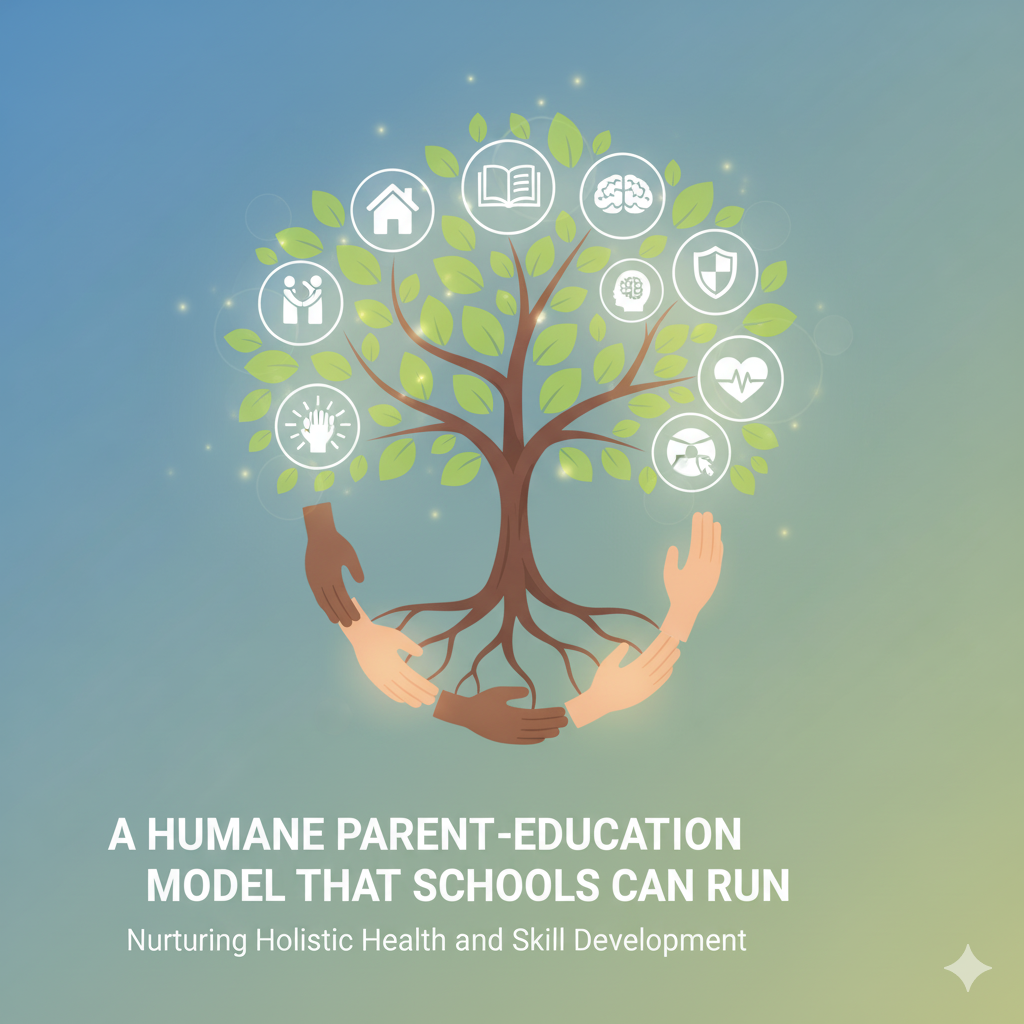
Nurturing Holistic Health and Skill Development
Education does not begin and end within classroom walls.
A child’s development is shaped equally by home environments, emotional climates, communication patterns and parental awareness. Yet, many school systems focus almost exclusively on academic outcomes, leaving a critical component underdeveloped — structured parent education.
If schools aim to nurture holistic growth, they must support not only students, but also the adults guiding them.
A humane parent-education model offers a sustainable way to strengthen this ecosystem.
Why Parent Education Matters in Schools
Children do not operate in isolation.
When schools emphasize discipline, learning methods and emotional regulation without aligning parents, inconsistency emerges. The child navigates two separate systems — school expectations and home habits — that may not always complement each other.
Parent education bridges this gap by:
- Strengthening communication between school and home
- Supporting emotional awareness in families
- Creating consistency in behavioral expectations
- Encouraging skill development beyond academics
Holistic education requires systemic thinking.
What Makes the Model Humane?
A humane model does not blame parents.
It does not impose rigid rules.
It does not assume deficiency.
Instead, it focuses on empowerment.
The foundation of a humane parent-education model includes:
- Emotional literacy
- Practical communication tools
- Growth mindset principles
- Structured reflection
- Skill-based parenting strategies
Parents are not passive recipients of school policies — they are partners in development.
Core Pillars of the Model
1️⃣ Emotional Awareness
Parents benefit from understanding:
- How emotions influence behavior
- How to regulate reactions
- How to model calm responses
Children learn emotional regulation through observation, not instruction alone.
2️⃣ Skill Development Beyond Academics
Academic excellence is important, but it is incomplete without:
- Decision-making skills
- Responsibility
- Adaptability
- Resilience
- Collaboration
Schools can introduce workshops that guide parents in reinforcing these skills at home.
3️⃣ Consistent Language and Expectations
When parents and teachers share common language patterns around:
- Effort
- Accountability
- Problem-solving
- Growth
Children experience stability and clarity.
Alignment reduces confusion and increases confidence.
How Schools Can Implement This Model
The model does not require large structural overhaul.
It can begin with:
- Monthly parent workshops
- Skill-based interactive sessions
- Communication guides for families
- Reflection exercises
- Structured feedback loops
Schools can integrate parent education into existing academic calendars.
Consistency, not complexity, drives impact.
The Long-Term Impact
When schools adopt a humane parent-education model:
- Behavioral issues decrease
- Emotional resilience increases
- Academic engagement improves
- Parent-school trust strengthens
Most importantly, children experience a cohesive support system.
Holistic health becomes a shared responsibility.
Closing Reflection
Education is not merely the transfer of knowledge.
It is the cultivation of character, skills and emotional intelligence.
A humane parent-education model recognizes that sustainable growth requires alignment between school and home.
When parents and educators collaborate intentionally, children thrive not only academically — but developmentally and emotionally.
🌿 Partner with BloomByond
BloomByond works with schools and families to design structured parent-education programs that strengthen holistic development and skill growth.
If your institution is exploring sustainable parent engagement models or families looking for these programs, connect with us to design a customized framework.