
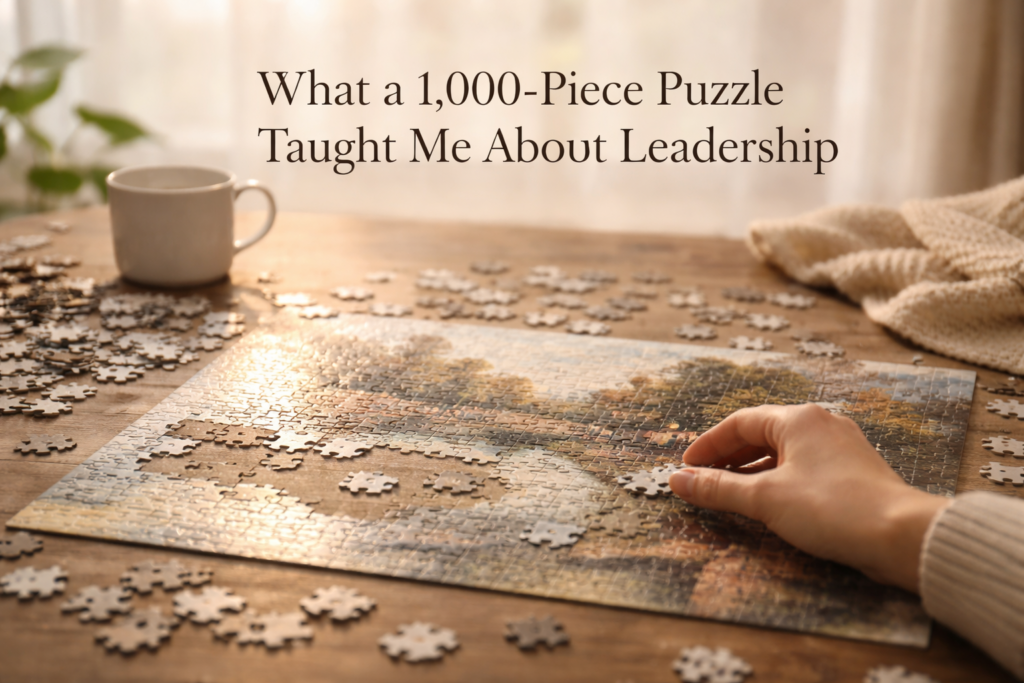
There is something deceptively simple about sitting down with a 1,000-piece puzzle. No deadlines. No KPIs. No audience. Just scattered fragments waiting for coherence.
Yet, what appears to be a leisurely activity quietly mirrors leadership, learning, and long-term growth more accurately than many structured workshops.
When I began assembling a 1,000-piece puzzle, I did not anticipate it becoming a masterclass in patience. But as the hours unfolded, so did deeper realizations about how progress truly works — in teams, in education, and in life. This reminds me of delegation and team dynamics, as discussed in a blog about NLP mindset changes for enhanced delegation and team ownership.
The Illusion of Immediate Clarity
At the start, everything looks chaotic. Pieces seem unrelated. Progress feels invisible.
Leadership often begins the same way.
When stepping into a new project, a new system, or even guiding a child’s development, clarity rarely arrives instantly. We expect quick alignment, rapid outcomes, and visible structure. Instead, what we encounter is ambiguity.
The puzzle reminded me:
Clarity is not discovered.
It is assembled.
Patience as a Strategic Skill
In a puzzle, forcing the wrong piece damages the structure.
In leadership, forcing outcomes creates resistance.
Patience is often misunderstood as passivity. In reality, it is strategic restraint — the ability to wait, observe, and adjust without losing direction.
Each piece that did not fit required:
- Re-evaluation
- Repositioning
- Sometimes complete reframing
The same applies to learning systems, delegation, and personal growth. Not everything fits on the first attempt.
Progress Is Non-Linear
There were moments when visible progress stalled. Long stretches of searching yielded no immediate success.
Then suddenly, a cluster of pieces would connect at once.
Learning works this way.
So does emotional regulation.
So does building trust within teams.
Growth is rarely linear. It compounds silently before becoming visible.
What This Means for Leadership and Learning
The puzzle reinforced three core leadership insights:
- Structure matters. Starting with the edges creates orientation. In leadership, clarity of boundaries and expectations anchors teams.
- Context accelerates alignment. Grouping by color and pattern mirrors how shared vision helps teams connect faster.
- Completion requires endurance. Motivation fades; discipline sustains progress.
These principles apply equally to raising children, building organizations, and developing personal mastery.
Applying the Puzzle Framework to Real Life
Here are practical ways to implement these lessons:
- Define the “edges” first — clarify scope before execution.
- Allow room for iteration without labeling it failure.
- Normalize slow progress in learning environments.
- Recognize invisible effort before visible results.
- Resist the urge to force premature solutions.
Leadership is not about having all the pieces immediately. It is about committing to the assembly process.
A Quiet Reminder
When the final piece clicked into place, the satisfaction was not just about completion. It was about endurance.
The puzzle did not reward speed.
It rewarded persistence.
In a world obsessed with acceleration, the deeper lesson was simple:
Sustainable growth is assembled patiently.
Closing Reflection
Whether guiding a child, leading a team, or building your own path, remember:
Progress may look fragmented today.
But with clarity, patience, and structured effort, the bigger picture always begins to emerge.
🌿 Continue the Journey
If leadership, learning, and emotional growth are areas you are actively developing — whether for yourself, your family, or your organization — explore BloomByond’s coaching and training programs designed to integrate mindset, structure, and sustainable development.


Pingback: 3 NLP Mindset Shifts for Stronger Delegation and Team Ownership – Bloom Byond Wellness